

The diesel that pushes some fifty thousand pounds of boat. Where it came from, what it is, what it is known for, and what goes wrong.
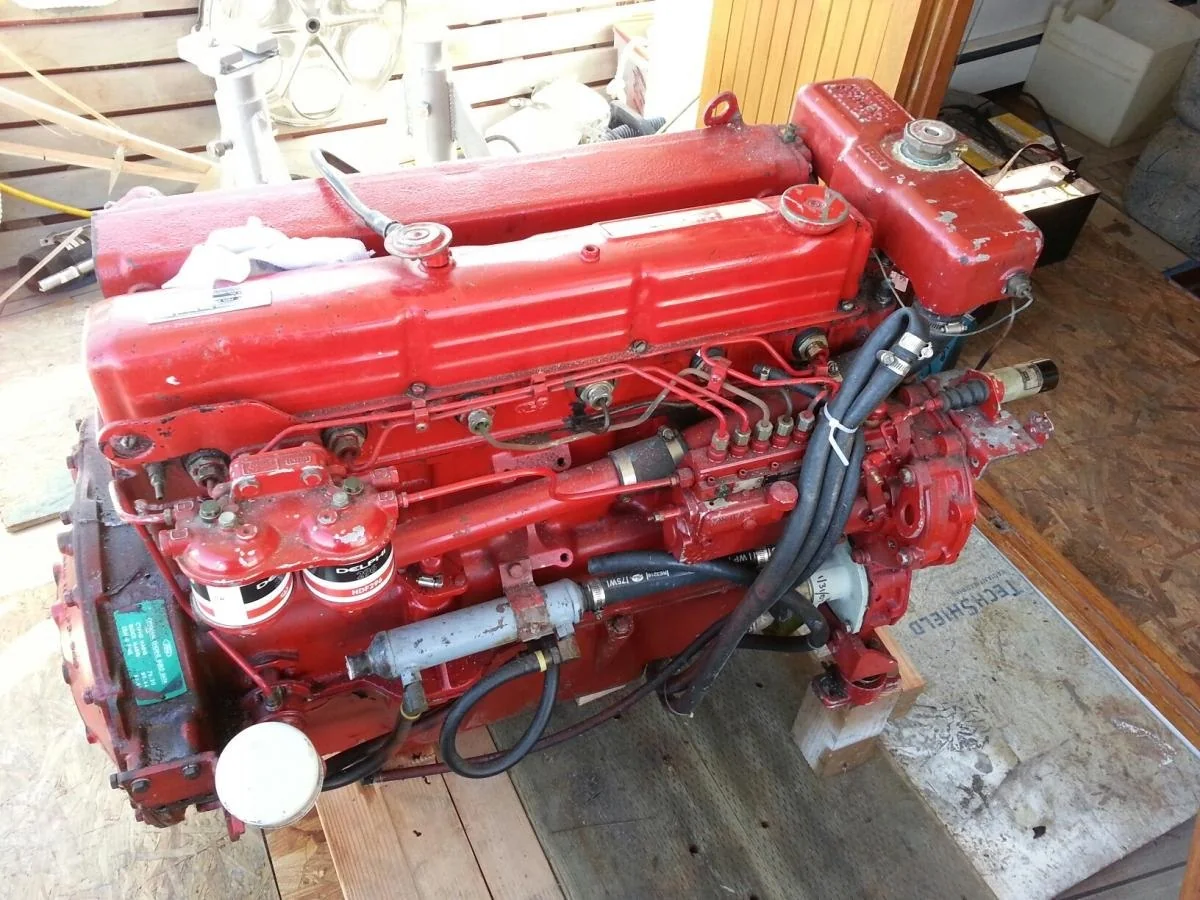
A Ford Lehman 120.
A British lorry engine that went to sea and never left
If you have spent any time around older trawlers and heavy cruising boats you have heard this engine. It is slow, it is heavy, it is naturally aspirated, and people who own them tend to get oddly sentimental about them.
It is not a marine engine. It is a Ford of Britain lorry engine, built at the Dagenham plant just east of London, and designed to haul loads around Britain in the Ford D-Series truck.
The engine is from Ford's Dorset family, and the specific one in most boats is the 2715E, built roughly between 1970 and 1981. In industrial form it sat in trucks, generators and pumps.
Lehman took that industrial engine and marinized it — heat exchanger, raw water cooling, marine gearbox, marine exhaust, instruments — and sold it as the Lehman 120, designation 6D380. Six cylinders, and the 380 is the displacement in cubic inches, about six and a quarter liters.
| Base engine | Ford 2715E, Dorset family |
|---|---|
| Built by | Ford of Britain, Dagenham |
| Production years | Roughly 1970–1981 |
| Originally for | Ford D-Series lorries and industrial use |
| Marinized by | Lehman, as the Lehman 120 (6D380) |
| Cylinders | 6, in line |
| Output | 120 hp |
| Aspiration | Naturally aspirated — no turbo |
Six liters making 120 horsepower is, by any modern standard, barely trying.
A modern engine of the same size would be turbocharged and intercooled and making three or four times the power. That's a better engine in almost every measurable way — lighter, cleaner, more economical, far more powerful.
It will also not be running in fifty years, and this one is.
A lightly stressed engine runs cool, runs at low revs, and the loads on every bearing and every piston are a fraction of what the metal can take. There is no turbo to fail, no intercooler, no high pressure common rail, and no electronics at all. Stop the fuel and it stops; give it fuel, air and cooling and it runs. You can fix one with hand tools and a manual.
That is the whole appeal, and for a boat heading somewhere with no dealer network it is a serious argument.
The marinized Lehman versions were fitted with a two-shaft raw water pump — Lehman's own development of a Jabsco rubber-impeller pump — mounted just below the fuel injection pump.
Both that raw water pump and the directly driven injection pump are turned off the engine's timing gears, and between them they are widely reported to cause rapid wear of those gears.
When a helical timing gear fails, it does not fail quietly. The valve timing goes with it and the damage inside the engine is serious and expensive.
If you own one: this is the item to ask your mechanic about by name, and to have inspected on any survey. It is a known characteristic of this specific marinization, not a general diesel problem.
These are the commonly reported ones rather than anything measured on this particular engine — treat them as a list of things to check, not a diagnosis:
A forty-year-old engine from a company that no longer makes it should be a parts nightmare. It isn't, and that is largely down to one business.
Bob Smith joined Roger Lehman in 1959 and helped engineer the Lehman marinization of the Ford-UK diesels — he is, as much as anyone, the reason these engines exist in boats at all. He went on to be managing director at Lehman Power, and when he left he founded American Diesel Corporation in 1981, in Virginia.
American Diesel has carried the parts, the knowledge and the part numbers for these engines ever since. Bob has since died; his son Brian runs the company now.
If you own a Ford Lehman, they are the first call. Not just for parts, but because they know which ones actually fit, which supersessions are correct, and what tends to go wrong.
Keeping it. The plan isn't to replace it with something modern — it is to give the old engine the instrumentation it never had: oil pressure, temperatures in and out, RPM and running hours, logged and trended rather than glanced at on a forty-year-old gauge.
An engine this simple doesn't need to be clever. It just needs somebody watching it properly.
Engine and generator monitoring → Logging the hours automatically