

Fifty-one feet of heavy-displacement fiberglass, designed by William Garden and built in Taiwan. The kind of boat made to cross oceans slowly and arrive anyway.
Sassafras River, Chesapeake Bay
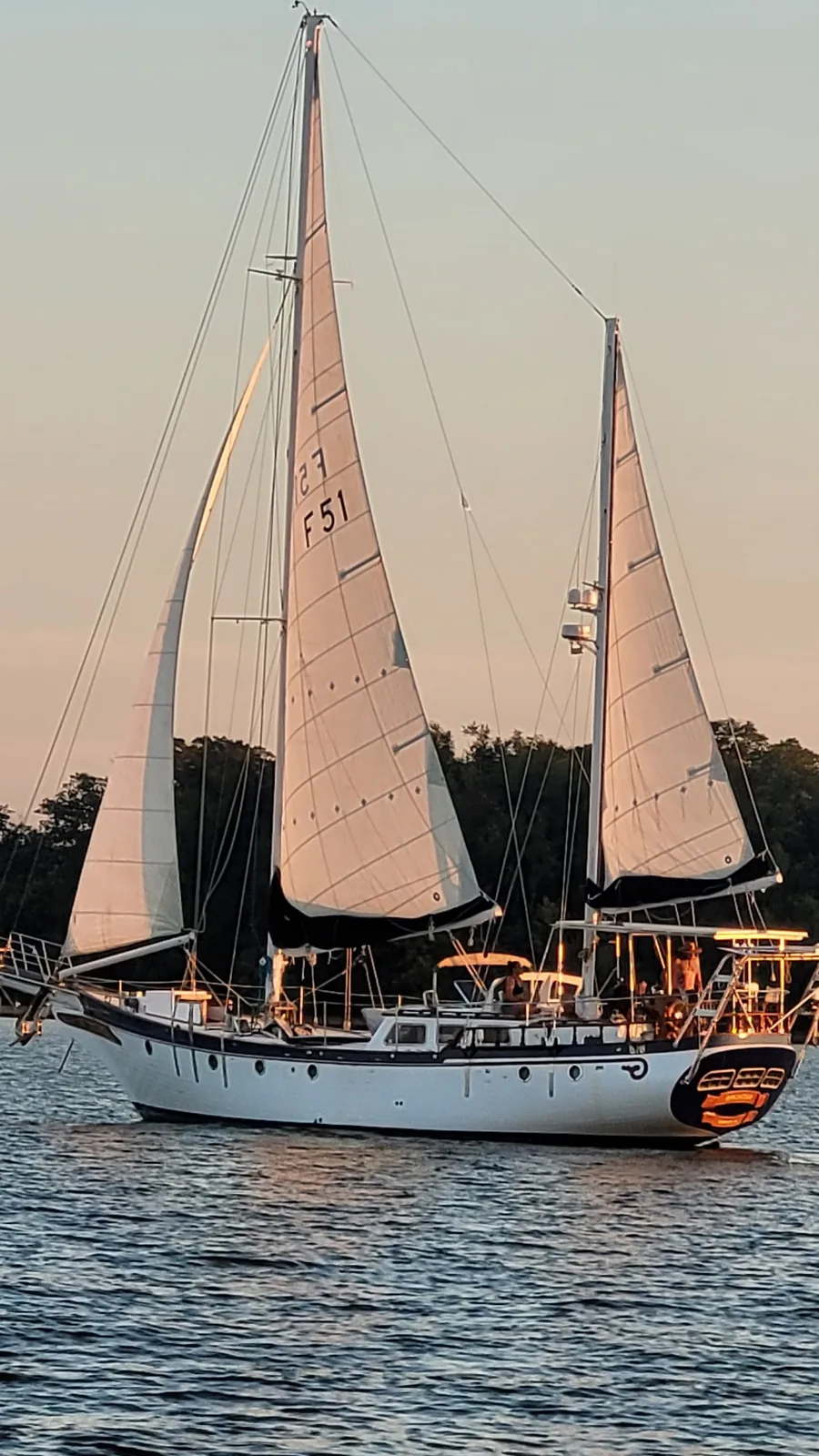
Main, mizzen and headsail. Fifty-one feet of her, doing what she was built to do. More photos →
Formosa 51, as a class
| LOA | 50 ft 10 in | Displacement | 52,000 lb |
|---|---|---|---|
| LWL | 39 ft 7 in | Ballast | 12,000 lb iron |
| Beam | 14 ft 1 in | Passage speed | 6–7 kn |
| Draft | 6 ft 2 in | Keel | Long keel |
| Rig | Ketch | Designer | William Garden |
| Hull | Solid glass, 1¼ in | Built | Taiwan, about 1972–1984 |
The numbers people ask about
| Rig (I · J · P · E) | 54.7 · 18.3 · 48.3 · 19.0 | SA/D | 14.5 | Comfort | 55 |
|---|---|---|---|---|---|
| D/L | 374 | Ballast ratio | ~23% |
Built by Formosa Boat Building Co. in Taiwan. What do those last three actually mean? →
The Formosa 51 as drawn
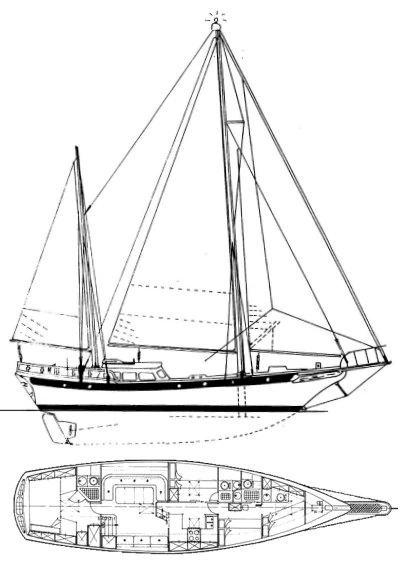
Ketch rig over a long keel, and the accommodation below. You can see the shape of her in the profile — deep forefoot, long run aft, and an outboard rudder on a full keel.
A guide to any listing, not just this one
Every boat for sale anywhere is described with the same handful of letters and ratios. Learn them once and you can read a listing properly — and more usefully, you can tell when a boat is being sold as something it isn't.
| Term | What it is | Why you care |
|---|---|---|
| LOA Length overall |
Hull end to hull end. | The marketing number. It's what gets printed on the brochure. |
| LOD Length on deck |
Same, but ignoring bowsprits and pulpits. | Closer to honest on a boat with a long sprit. |
| LWL Waterline length |
How much boat is actually in the water. | This is the one that matters. Hull speed, motion and most of the ratios come off LWL, not LOA. |
| Beam | Widest point. | Room below, initial stiffness — and, past a point, vulnerability to being rolled. |
| Draft | Keel bottom to waterline. | Where you can and can't go. Decides more of your cruising life than anything else here. |
Displacement is simply what the boat weighs — and because a floating boat pushes aside exactly its own weight in water, it's also the weight of water she displaces. Hence the name. Usually quoted half-loaded with stores, fuel and crew, which means the real number afloat and cruising is higher. Often a lot higher.
Ballast is the dead weight down low that keeps her upright. Ballast ratio is ballast divided by displacement, as a percentage. Thirty to forty-five percent is normal cruising territory.
But the ratio on its own can mislead. Where the ballast sits matters as much as how much there is — a deep bulb keel does far more with the same weight than ballast spread along a long shallow keel. Two boats with identical ballast ratios can behave completely differently.
Four letters, and they're just the sides of two triangles. Once you see that, they stop being jargon.
| Letter | Measured |
|---|---|
| I | Deck up to where the forestay meets the mast. The height of the foretriangle. |
| J | Front of the mast forward to where the forestay hits the deck. The base of the foretriangle. |
| P | Mainsail luff — how far the main hoists up the mast. |
| E | Mainsail foot — how far it stretches along the boom. |
From those you get the sail areas, because both are triangles: foretriangle = I × J ÷ 2 and mainsail = P × E ÷ 2.
A ketch or yawl adds a second set for the mizzen, usually written Iy, Jy, Py, Ey. Exodus is a ketch, so her total working sail area is spread over a main, a mizzen and the headsails — which is the real point of the rig. Same area, cut into smaller pieces, each one easier for two people to handle at three in the morning.
Heel a boat over and gravity pulling down on the ballast and buoyancy pushing up on the hull act in opposite directions, separated by a distance. That distance is the righting arm, and righting moment = righting arm × displacement. It's the force trying to stand her back up, and it's measured in foot-pounds.
The thing to understand is that it changes with heel angle. Plot righting moment against heel and you get a curve, and the curve is the real story of how a boat behaves:
Where the curve crosses zero is the angle of vanishing stability — the AVS, or limit of positive stability. Past that angle the righting moment goes negative and the boat is happier upside down than the right way up.
This is the single most important number for offshore sailing and it is almost never in the listing. For a boat going properly offshore you want an AVS somewhere north of 120 degrees. Plenty of modern wide, shallow coastal boats are down in the low hundreds — fine in the bay, a different proposition in a breaking sea.
Sail area to displacement (SA/D)
Power to weight. Sail area in square feet, divided by displacement expressed as a volume, to the two-thirds power. Rough reading:
| under 15 | Heavy cruiser. Needs real wind to get going. |
| 15–20 | Ordinary cruising boat. |
| over 20 | Performance. Also more sail to handle when it blows. |
Displacement to length (D/L)
Weight relative to waterline length — how heavy she is for her size. Displacement in long tons divided by (0.01 × LWL) cubed.
| under 100 | Ultralight |
| 100–200 | Light |
| 200–275 | Moderate |
| 275–350 | Heavy |
| over 350 | Very heavy. Traditional bluewater territory. |
Capsize screening formula (CSF)
Written by the Cruising Club of America's technical committee after the 1979 Fastnet, on the observation that beam helps you capsize and weight stops you. It's maximum beam divided by the cube root of displacement expressed as a volume in cubic feet.
Under 2.0 is considered acceptable for offshore. Lower is better. It is a screening tool — it was designed to flag boats worth a closer look, not to be a verdict.
Comfort ratio
Ted Brewer's, and he was half joking when he wrote it. The idea is that what makes people seasick isn't how far a boat moves but how quickly — the short, snappy motion of a light hull in a chop. It weighs displacement against length and beam:
Comfort = Displacement / (0.65 × (0.7 LWL + 0.3 LOA) × Beam^1.33)
| under 20 | Light. Lively, and you'll know about it. |
| 20–30 | Coastal cruiser. |
| 30–40 | Average cruiser. |
| 40–50 | Heavy offshore cruiser. |
| 50–60 | Heavy oceangoing. Slow, steady, dry. |
Brewer himself was clear it's a rule of thumb, not physics, and people lean on it harder than he ever intended. It says nothing about hull shape, rig balance, or how well the boat is handled.
Every ratio on this page is arithmetic done on four or five published measurements. They cannot see how the boat is built, how the keel is attached, whether the chainplates are sound, how the companionway closes, or how well she's sailed.
A well-found boat with mediocre numbers and a crew who know her will go places a perfect-on-paper boat won't. Use these to understand what kind of boat you're looking at, not to decide whether it will keep you alive.
52,000 lb on fifty feet is heavy. About 12,000 lb of that is iron ballast in a long keel — a ballast ratio around 23%. That is below the thirty to forty-five percent quoted above, but as that section says, the ratio on its own can mislead on a boat this heavy with a long keel. The comfort ratio and displacement to length say more about how she moves.
SA/D around 14 puts her firmly in the first row of that table. She is not quick. Six or seven knots is the honest number. In exchange you get a boat that tracks, that can be left to steer herself, and that doesn't need reefing every time the wind shifts.
A comfort ratio above 50 is the top band — heavy oceangoing. It is the arithmetic way of saying she rolls slowly and doesn't throw you across the saloon.
An inch and a quarter of solid glass below the waterline. That one isn't a ratio and it doesn't appear in any listing. Nobody builds like that now because nobody needs to pay for it. It's the single biggest reason these boats keep turning up having circumnavigated.
Put together, the numbers describe exactly one kind of boat: slow, heavy, forgiving and hard to stop. Which is the boat we went looking for.